
Essential Dog Supplies for Beginners: 2026 Checklist
Table of Contents
- The Essential Dog Supplies for Beginners Checklist
- Walking Gear: Harnesses, Leashes, and Waste Disposal
- Feeding and Comfort Essentials: Bowls, Beds, and Treats
- Grooming and Hygiene Supplies for Everyday Care
- Best Dog Training Supplies for Beginners
- How to Puppy Proof Your Home Before They Arrive
- Budget vs Premium: Where to Spend and Where to Save
- Frequently Asked Questions
Last Updated: October 4, 2026
The Essential Dog Supplies for Beginners Checklist
Bringing home a new dog is exciting, but the shopping list can feel endless.
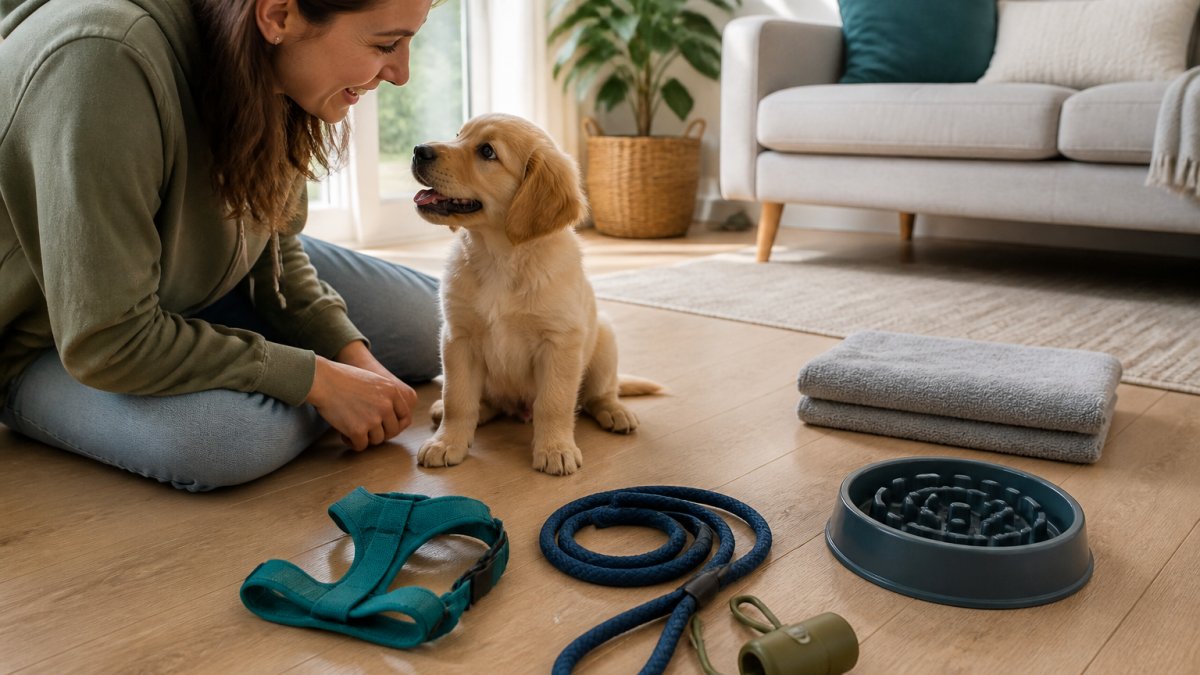
The American Society for the Prevention of Cruelty to Animals recommends preparing your home before your dog arrives, because the first 48 hours shape how settled a dog feels.
Below, we break down what to buy before day one, what can wait, and where your money matters, plus the two things new owners most often get wrong: harness sizing and puppy-proofing.
What to Buy Before Day One vs What Can Wait
Buy these before your dog comes home: a fitted harness, a leash, food and water bowls, a bed, waste bags, and a basic grooming tool. Everything else, including training devices and extra toys, can wait until you understand your dog's habits.
Before day one:
- Step-in harness and leash
- Food and water bowls
- A washable bed
Wait a few weeks:
- Training devices
- Specialty feeders
- Multiple toys
Walking Gear: Harnesses, Leashes, and Waste Disposal
A well-fitted harness is the most important piece of walking gear for a beginner.
Our Step-In Dog Harness Bundle comes with a matching rope leash and is built with a heavyweight webbing core, four layers of fabric, and triple-stitched stress points.

For owners who want more freedom on open walks, the Automatic Retractable Leash extends to 5 meters. It suits calm dogs in low-traffic areas, not busy pavements.
Waste disposal is the item people forget.
How to Measure for a Harness That Actually Fits
Measure the deepest part of the chest, right behind the front legs, all the way around. If your measurement lands at the top of a size range, size up. Use a soft tape measure, snug but not tight, a harness should allow two fingers under the strap at the chest. Recheck the fit after a month, since a harness that fit in week one may rub by week six.
| Harness Size | Chest Girth | Strap Width | Typical Max Weight |
|---|---|---|---|
| Extra Small | 9-15 in | 1/2 in | 10 lb |
| Small | 14-21 in | 5/8 in | 20 lb |
| Medium | 17-24 in | 3/4 in | 40 lb |
| Large | 22-30 in | 1 in | 85 lb |
Feeding and Comfort Essentials: Bowls, Beds, and Treats
Feeding gear and bedding are where comfort and health meet: a slow feeder helps dogs that gulp their food, and a washable bed keeps the sleeping area hygienic.
The Slow Feeder Pet Bowl uses raised ridges to divide food into smaller sections, encouraging a slower eating pace.

For bedding, the Universal Pet Dog Bed comes in sizes S through 2XL with a removable, washable cover.
Treats belong in the training budget, not the feeding budget.
Grooming and Hygiene Supplies for Everyday Care
Basic grooming prevents bigger problems: a way to clean paws after walks, a towel for damp coats, and a brush for bath time.
The Manual Dog Paw Cleaner Cup handles muddy paws without a full bath.
Bath time gets easier with the Dog Bath Massage Brush, which has a built-in shampoo dispenser and soft silicone tips that distribute shampoo evenly and remove loose fur.

Best Dog Training Supplies for Beginners
The best dog training supplies for beginners are a clicker or marker, high-value treats, and a long line. Electronic devices are optional and should come later, once basic positive reinforcement is working. Positive reinforcement rewards the behavior you want instead of punishing what you don't, start with treats and a marker word, then add tools as your dog's focus improves.
The 4-in-1 Remote Dog Training Device combines sound, vibration, and other modes for bark control and behavior correction.
How to Puppy Proof Your Home Before They Arrive
Puppy-proofing means removing hazards at floor level before your dog explores. Get down on your hands and knees and check every room from your dog's height. But the risks depend on where you live and how big your dog will get: a Great Dane puppy can reach countertops by month four, while a Chihuahua may never see the top of a sofa.
The Universal Baseline (Do These First, Regardless of Home Type)
- Move electrical cables behind furniture or into cord covers
- Secure bin lids and move cleaning products to locked cupboards
- Pick up small objects, hair ties, and children's toys
The ASPCA's guide to toxic and non-toxic plants is the fastest way to check whether a plant in your home is safe.
Apartment Puppy-Proofing: What Changes When You Share Walls
In an apartment, you cannot control hallway noise, neighbor doors, or shared ventilation. Your puppy-proofing must account for these shared-space realities.
Entryway and hallway:
Step-In Dog Harness Bundle – Sky Blue (2 Pieces) →
- Add a mat or shoe tray to contain outdoor debris, apartment hallways track in more than a house entryway.
- Use a door draft stopper to reduce hallway noise that can trigger barking.
- Secure your door so a puppy cannot bolt into a shared corridor. A baby gate inside the door creates an airlock.
Balcony and windows:
- Check balcony railings for gaps wider than 4 inches. Small breeds can slip through.
- Never leave a puppy unsupervised on a balcony, even on a high floor. Screens are not a barrier.
- Use window locks or restrictors if you open windows for ventilation.
Indoor potty setup:
- If you plan to use potty pads during the first weeks (common in high-rise buildings), designate a spot away from food and sleep areas.
- For apartment dwellers, a fresh patch of grass or a porch potty can bridge the gap until your puppy is fully vaccinated and can use outdoor areas.
Noise and enrichment:
- Apartments amplify sound. A white noise machine or a fan near your puppy's crate can mask hallway noise.
House Puppy-Proofing: Yard, Garage, and Multi-Level Risks
A house offers more space but also more escape routes and hazards.
Yard and fence line:
- Walk the fence line and check for gaps, loose boards, or dig spots. A puppy can squeeze through a gap you can barely see.
- Check gate latches. A puppy can learn to push a loose latch surprisingly fast. Add a carabiner or spring-loaded latch for security.
- Identify toxic outdoor plants, including sago palms, oleander, and azaleas. The ASPCA list covers both indoor and outdoor plants.
Garage and storage:
- Antifreeze, fertilizers, and rodenticides are top toxins. Store them in locked cabinets, not open shelves.
- Secure sharp tools, nails, and screws. A puppy exploring a garage can step on or swallow small hardware.
Stairs and multi-level homes:
- Block stairs with a gate until your puppy can manage them safely. Repeated stair descents can stress growing joints in large breeds.
- Use baby gates at the top and bottom of stairs, not just the bottom.
Size and Breed-Specific Hazards Beginners Miss
A 5-pound Chihuahua puppy and a 100-pound Great Dane puppy face different risks in the same home.
Small breeds (under 20 lb adult weight):
- Gaps under furniture, behind appliances, and between sofa cushions are prime hiding spots. Block them with foam noodles or rolled towels.
- Reclining chairs and sofa mechanisms can crush a small dog. Check under furniture before reclining.
- Small puppies can slip through balcony railings and fence gaps that would stop a larger dog.
Large and giant breeds (over 50 lb adult weight):
- Counter-surfing starts early. A large-breed puppy can reach countertops by 4-6 months. Keep food, medications, and knives pushed back.
- Trash cans must be heavy or locked. A large puppy can tip a standard bin.
- Door handles and lever-style latches are within reach sooner than you expect. Consider childproof covers.
Budget vs Premium: Where to Spend and Where to Save
Most beginner guides say 'spend on quality' without defining what that means. New owners face a stack of purchases in the first month, and not all deserve premium spending. Below is a tiered framework separating Starter Budget essentials from Long-Term Investment items.
The Starter Budget Tier: What You Actually Need on Day One
These items get you through the first 30 days without overspending, functional, safe, and replaceable.
| Item | Budget Approach | What to Look For |
|---|---|---|
| Harness | Basic step-in or H-style | Adjustable chest strap, sturdy buckles, no sharp edges |
| Leash | 4-6 ft nylon or rope | Strong clip, comfortable handle |
| Bowls | Stainless steel or ceramic | Heavy base so it doesn't slide, dishwasher-safe |
| Bed | Washable, correct size | Removable cover, enough room to stretch out |
| Waste bags | Any standard roll | Thick enough to prevent leaks |
| Grooming | One brush or towel | Matches your dog's coat type |
Where to save in the starter tier:
- Skip the designer collar. A basic adjustable collar works fine for ID tags.
- Skip the full grooming kit. Buy one tool that matches your dog's coat, not a 10-piece set.
- Skip the premium food storage container. A clean, sealed bin from a general retailer works.
The Long-Term Investment Tier: Where Premium Pays Off
These are items you will use daily for years. Spending more here often saves money, because cheap versions wear out, cause discomfort, or need replacing.
| Item | Why Premium Matters | What to Look For |
|---|---|---|
| Harness | A poorly fitted harness causes rubbing, chafing, and escape attempts. A quality harness lasts through growth and daily walks. | Padded straps, multiple adjustment points, reflective stitching |
| Bed | A cheap bed flattens or tears within months. A washable, durable bed protects your investment and your dog's joints. | Orthopedic foam for large breeds, water-resistant liner, machine-washable cover |
| Slow feeder | Cheap plastic can crack or harbor bacteria. A quality slow feeder is easier to clean and lasts longer. | Food-safe material, non-slip base, dishwasher-safe |
| Training treats | High-value treats make training faster and more reliable. Low-value treats get ignored in distracting environments. | Small size, strong smell, limited ingredients |
| Long line | A cheap long line tangles or snaps. A quality one gives you control during recall training. | Lightweight, easy to grip, appropriate length for your training area |
How to Prioritize When Your Budget Is Tight
If you can only spend a limited amount in the first month, follow this order:
- Safety first: Harness, leash, ID tag, and a safe confinement option (crate or playpen).
- Health basics: Food, water bowls, and a way to clean up waste.
- Comfort: A washable bed and one grooming tool.
- Training: Treats and a clicker or marker word. Skip electronic devices until basics are solid.
- Enrichment: Two or three toys, rotated. Add more as you learn what your dog enjoys.
New owners often spend heavily on toys in week one, then realize they need a better harness or a larger bed by week six. Buying the starter tier first and upgrading daily-use items as you learn your dog's habits is almost always cheaper than buying premium everything upfront.
Breed and Size Change the Budget Equation
A Chihuahua and a Great Dane have different supply costs, even for the same categories.
- Small breeds: Less material means lower prices for beds, harnesses, and crates. But small breeds often need more enrichment toys to stay busy indoors, and their tiny sizes can make some products harder to find in budget lines.
- Large and giant breeds: Everything costs more, beds, crates, harnesses, and even food. A large breed can go through a bed in months if it is not durable. For these dogs, the long-term investment tier matters more because cheap gear fails faster under weight and wear.
- Breed-specific needs: A husky may need a specialty brush and more durable toys; a poodle may need professional grooming tools; a bulldog may need a harness that avoids pressure on the throat and chest. Research your breed's specific needs before buying generic starter kits.
Sustainability on a Budget
Reusable waste bags, washable potty pads, and durable webbing cost more upfront but reduce long-term waste and replacement costs. Look for removable, washable covers and avoid single-use items where a reusable option exists.
Frequently Asked Questions
What are the first things I need to buy for a new dog?
Start with the daily-use items: a properly fitted harness or collar, a leash, food and water bowls, a waste bag dispenser, and a bed. Add a slow feeder if your dog eats quickly, and a microfiber towel for damp walks. Training rewards like small crunchy treats help from day one. Hold off on specialty gear until you know your dog's size, chewing style, and energy level.
Do I need to buy everything before bringing my dog home?
No. Cover the basics for the first week: walking gear, feeding bowls, a bed, waste bags, and a few treats. Items like grooming tools, puzzle toys, and training devices can wait until you see what your dog actually needs. Buying everything upfront often leads to unused gear, especially if you guess the wrong harness size or your dog ignores certain toys.
How do I prepare my home for a new dog?
Walk each room at floor level and remove anything chewable or toxic: loose cables, small objects, cleaning products, and houseplants. Secure bins, block off stairs if needed, and set up a quiet zone with a bed where your dog can retreat. Keep waste bags and cleaning supplies near the door for quick cleanups, and store treats out of reach so they do not become a target.
What training supplies do beginners actually need?
A clicker or marker word, small high-value treats, and a short leash cover most early training. The Wooflies Peanut Butter Crunch Bites work well for reward-based sessions because they are bite-sized and crunchy. A long line helps with recall practice in safe areas. Remote training devices exist.
Should I choose a harness or a collar for a new dog?
A harness gives you more control and takes pressure off the throat, which matters for dogs who pull. The Wooflies Step-In Dog Harness Bundle comes in four sizes based on chest girth, so measure right behind the front legs before ordering. Collars still matter for ID tags. Many owners use both: a harness for walks and a collar for identification.