
Best Dog Toys for Mental Stimulation: Top Picks & Tips
Table of Contents
- Why Mental Stimulation Matters for Your Dog
- Types of Interactive Puzzle Toys for Dogs
- How to Choose the Best Dog Toys for Mental Stimulation
- DIY Dog Enrichment Ideas for Home
- How to Keep a Dog Busy While at Work
- Cleaning and Maintaining Your Dog's Toys
- Integrating Toys into Training and Daily Routines
- Frequently Asked Questions
Last Updated: September 28, 2026
Why Mental Stimulation Matters for Your Dog
A tired dog is not always a fulfilled dog. Physical exercise alone leaves the brain underworked, and that gap shows up as chewing, barking, and pacing. The best dog toys for mental stimulation close that gap by giving your dog a problem to solve.
Canine enrichment is the practice of engaging a dog's natural instincts, such as foraging, scenting, and problem-solving, through purposeful activity. Mental work tires dogs in a different way than a long walk does. Ten minutes of focused puzzle solving often settles a dog more effectively than thirty minutes of fetch, because it works the brain rather than just the body.
This guide breaks down the toy types, selection criteria, and routines that actually hold a dog's attention. Below, we'll show you exactly how to match a toy to your dog's age, breed, and energy level, plus the maintenance habits most owners skip.
Types of Interactive Puzzle Toys for Dogs
Interactive puzzle toys fall into a few clear categories, each targeting a different instinct. Knowing the category helps you predict whether your dog will stay interested past the first week.
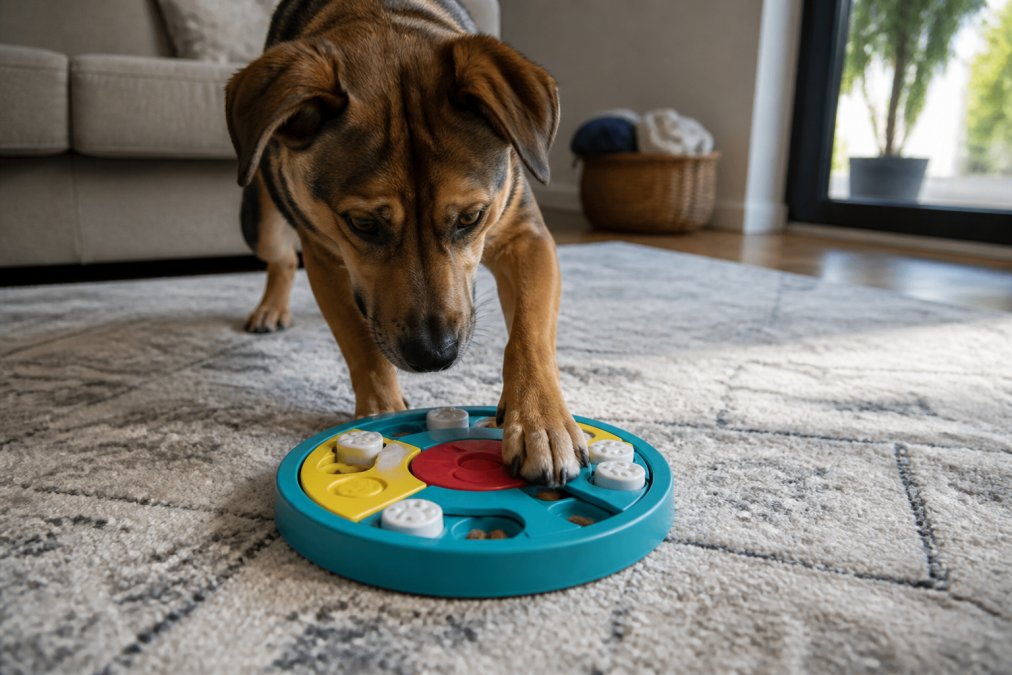
The main categories are:
- Treat-dispensing toys that release food as the dog rolls or nudges them
- Snuffle mats that mimic foraging by hiding kibble in fabric strips
- Slow feeders that turn mealtime into a problem to solve
- Chew-resistant rubber toys built for dogs who destroy softer options
- Scent-work games that reward tracking and searching
Treat-Dispensing Toys for Beginners
Treat-dispensing toys are the easiest entry point for a dog new to puzzles. The dog nudges, rolls, or paws the toy, and food falls out as a reward. Start with a low-difficulty design where kibble releases easily, then increase the challenge as your dog learns the game.
A common mistake is starting with the hardest setting. That teaches frustration, not problem-solving. Let your dog win early and often.
Durable Toys for Aggressive Chewers
Durable rubber toys matter most for dogs who shred plush toys in minutes. Look for solid, thick-walled rubber with no small parts that can break off. Chew resistance should match your dog's jaw strength, not just their size.
How to Choose the Best Dog Toys for Mental Stimulation
Choosing the best dog toys for mental stimulation comes down to three variables: your dog's age, energy level, and instinct profile. A toy that fits all three keeps working for months instead of days.
Use this framework before you buy:
| Factor | What to Check | Why It Matters |
|---|---|---|
| Age | Puppy, adult, or senior | Puppies need softer textures; seniors need lower difficulty |
| Chew style | Nibbler, shredder, or power chewer | Determines material and durability |
| Instinct | Forager, scent hound, or problem-solver | Matches toy type to motivation |
| Energy level | Low, moderate, or high | Sets how long a session should run |
| Supervision | Supervised or solo play | Rules out toys with loose parts |
Matching Toys to Your Dog's Breed and Energy Level
Breed history predicts what a dog finds rewarding. Retrievers often engage with toys they can carry and shake. Terriers prefer toys that mimic digging or hunting. Herding breeds tend to enjoy anything with a sequence of steps.
Energy level sets the length of a session. High-drive dogs may need several short sessions a day, while lower-energy dogs do well with one calm puzzle after a meal.
Safety Tips for Unsupervised Play
Supervised play is the default for any new toy. Once you know how your dog interacts with it, some toys are safe to leave out, but the rules stay strict.
- Check toys for cracks, loose seams, or missing pieces before each session
- Remove rope toys once they start fraying
- Avoid toys small enough to swallow whole
- Match toy size to your dog's mouth, not just their body
- Wash fabric toys regularly to prevent bacteria buildup
DIY Dog Enrichment Ideas for Home
DIY dog enrichment ideas cost little and work well when you want variety without buying more gear. The goal is to make your dog work for food or solve a small problem, but not every homemade activity is equally hard, and matching difficulty to your dog's experience level is what keeps the activity from becoming either boring or frustrating.
A useful way to organize DIY enrichment is by sensory channel, because different dogs are motivated by different inputs. A scent-driven hound may ignore a cardboard shredding station but work a hidden-treat trail for twenty minutes.
Olfactory (scent-based) DIY
- Towel roll-up: Scatter kibble across a bath towel, roll it lengthwise, and let your dog unroll it. Difficulty scales by how tightly you roll and whether you knot the ends.
- Room search: Hide five to ten treats around one room at nose height and floor level. Start with visible placements, then move to hidden spots under furniture edges as your dog improves.
- Cardboard sniff box: Poke treats into the folds of a flattened cardboard box. The dog must use nose and paws together to extract them.
Tactile (paw and mouth work) DIY
- Muffin-tin puzzle: Place treats in a muffin tin and cover each cup with a tennis ball. Dogs must lift or nudge the balls aside. This is a classic beginner puzzle because the solution is visible.
- Layered towel stack: Stack three towels with treats between each layer. The dog must pull layers apart rather than just sniff.
- Frozen stuffed toy: Freeze broth or plain yogurt inside a sturdy rubber toy. This is a long-duration activity best given before alone time, not as a quick distraction.
Auditory and problem-solving DIY
- Treat-filled cardboard box: Place kibble inside a closed cardboard box and let the dog shred it under supervision. The sound of tearing cardboard is itself reinforcing for many dogs.
- Nested boxes: Put a treat inside a small box, place that box inside a larger one, and so on. Each layer adds a step, which is how you build a sequence-based challenge for herding breeds.
Difficulty scaling rules that actually work
Most practitioners find that a good enrichment activity should be solvable in roughly two to five minutes the first time. If your dog gives up in under thirty seconds, the task is too hard, simplify it. If it's solved in under ten seconds, add a layer, tighten the roll, or hide the reward deeper.
How to Keep a Dog Busy While at Work
How to keep a dog busy while at work starts with preparation before you leave, not during the day. Set up activities that run on their own and don't need you in the room.
A practical routine looks like this:
- Give a frozen stuffed toy right before you leave
- Leave one snuffle mat or puzzle feeder out
- Rotate the selection the next day so nothing feels stale
- Schedule a midday walk or check-in if your dog struggles alone
Cleaning and Maintaining Your Dog's Toys
Cleaning is the step most owners skip, and it's the one that keeps toys safe and hygienic. Food residue inside a puzzle toy turns into bacteria fast, especially in warm weather.
Follow this schedule:
| Toy Type | Cleaning Method | Frequency |
|---|---|---|
| Rubber toys | Warm soapy water or dishwasher | Weekly |
| Snuffle mats | Machine wash, air dry | Every 1-2 weeks |
| Rope toys | Hand wash, full dry | Weekly |
| Puzzle feeders | Rinse after each use | Daily |
Integrating Toys into Training and Daily Routines
For owners who want a curated starting point, Wooflies offers a carefully chosen range of high-quality toys, practical feeding accessories, and everyday care products.
Frequently Asked Questions
What are some good mental stimulation toys for dogs?
Puzzle toys, treat-dispensing balls, snuffle mats, and durable chew toys are excellent for mental stimulation. These toys engage your dog's problem-solving skills and foraging instinct. For beginners, start with a simple treat-dispensing toy. For aggressive chewers, choose durable rubber toys. Always supervise initially and rotate toys to prevent boredom.
How often should I rotate my dog's puzzle toys?
Rotate puzzle toys every few days to keep them novel and engaging. Dogs can get bored with the same toy, so swapping them out maintains interest. A good rule is to have three to five toys in rotation, offering two or three at a time. Clean them regularly to ensure hygiene and safety.
Do vets recommend cognitive dog toys?
Yes, veterinarians often recommend cognitive toys to provide mental stimulation, which can reduce destructive behavior and anxiety. These toys mimic natural foraging and problem-solving, promoting behavioral health. However, always choose toys appropriate for your dog's size and chew strength, and supervise play to prevent accidents.
How can I keep my dog busy while I'm at work?
Provide a mix of interactive toys like puzzle feeders and frozen treat toys. Set up a rotation so your dog has different challenges throughout the day. You can also use a snuffle mat or hide treats around the house for scent work. Consider a pet camera to check in. These activities help prevent boredom and destructive behavior.
Choosing the right toys takes a little trial and error, and no single product fits every dog. Wooflies simplifies the process with a specialized selection of toys for cats and dogs, practical feeding accessories, and everyday care products, all in one straightforward shop. If you want durable, well-chosen options without guessing, get started with Wooflies and build an enrichment routine your dog actually looks forward to.